How do muscles and bones function during locomotion?
Strain Studies Images
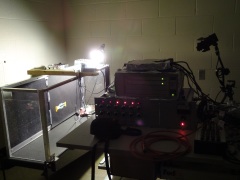
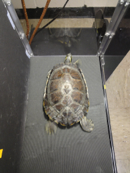
These studies grew out of my post-doctoral work with Rick Blob (Clemson University), and are performed in collaboration with Rick's lab. They involve implantation of Rosette bone strain gauges, Sonomicrometry crystals, and EMG fine wire electrodes. We are interested in understanding integrated function of the limb system during locomotion. Our first study used river cooter turtles as a model organism. The cooters were trained to walk on a treadmill and in vivo recordings of bone strain, and muscle strain and activation were made during level walking. Peaks of bone strain (axial and shear) were found to be closely correlated in time with peaks of muscle shortening strain. Hip/knee muscles directly contribute to compressive stress and strain on the turtle femur and helps to balance extensor moments at the knee joint at midway through the step. These novel data help refine our current models of bone loading via force platform analyses.
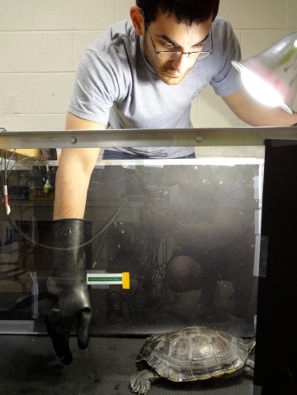
Brett Aiello working on cooter wrangling.
Photo: M.T. Butcher
Brett Aiello completed this analysis in turtles for his Masters Thesis and we have published his work in the Journal of Morphology. We have completed a similar analysis in the Virginia opossum. Bone strain recordings from the femur of the 9-banded armadillos are also now complete. Joe Copploe is currently working to finalize analysis of the bone strain data. He will be conducting mechanical property tests on armadillo femora in February 2014.
< Research
Turtle training
river cooter walking on the treadmill; typical experiments consist of 12-15 trails of walking.
Strain recording experiment
recording theatre